De bijzondere leerstoel ‘Vrijzinnige religiositeit en humanisme’ wordt vanaf 1 november 2025 bekleed door Timothy Stacy. In het engelstalige fragment hieronder, beschrijft hij fragmenten uit zijn levensloop die hem tot deze leerstoel hebben gebracht. Verder onderaan in de pagina staat de beschrijving van onze voormalige hoogleraar Laurens ten Kate.
My life in fragments
As a pre-schooler growing up in the UK, my parents took my three brothers and me to church every week. Till one day, seemingly out of the blue, we didn’t. Instead we went to playgrounds, country parks, or whatever my parents had thought up. The change was nothing. But it was also everything. The absence stayed with me for the rest of my life.
Following a move for my Dad’s work, I spent my teenage years in Moscow, Russia. I was a high performing ruffian. I loved learning. And I loved getting up to no good. I fell in love with a girl who turned out to be the daughter of a missionary. Everyone her parents approved of attended the Christian Youth Club that they ran. I didn’t. My wildness made me seem dangerous. My sharpness was not an advantage. Putting this alongside what I was learning about colonialism in history class, I started to hate Christianity.
Hoping to destroy theology from within, for my undergraduate degree I did a Joint Honours in Philosophy and Theology at the University of Nottingham. The theologians got to me. After three years I felt that there was one way to be an atheist but infinite ways to have faith.
During a subsequent MA in Philosophical Theology, I was particularly drawn go work that spoke to my personal feelings of religious loss: post-liberal philosophers and theologians like John Milbank, Alisdair Macintyre, and Charles Taylor, who argue that the decline of Christianity has led to a loss of a shared narrative and with it moral and political purpose. It is in this void that solidarity collapses and neoliberal economics takes hold. Given I was studying amidst the Global Economic melt down of 2008, the political response to which was bailing out the banks that got us into the mess and cutting social welfare to the poorest, the theory gripped me.
Yet at the same time post-liberal theory did not seem to make much sense of what I saw around me. Many of those I saw doing good works had little time for Christianity.
I therefore moved to London to undertake a PhD with the more empirically inclined Adam Dinham. My mission was to develop a theory of solidarity suitable for superdiverse spaces. I became particularly interested in the work of the sociologist Emile Durkheim, for whom religion was indeed central to maintaining solidarity, but for whom religion could mean anything from Christianity to the idea of freedom. I was further inspired by the radical pedagogy of Paulo Freire, who suggested any true revolution cannot come from the top down but rather must be cultivated from the bottom up.
In the summer of 2011, I was sitting in my dark bedroom in North London, reading books about solidarity, when riots broke out around the corner. As the riots spread across the country, I decided to put my books down and join a group trying to clean up the mess and rebuild community. The decision changed my life. Instead of theorising from an armchair, I would work alongside community organisers and activists, telling the story of how they build solidarity. With a background in philosophy and theology, I saw my work as a corrective to claims that we must restore Christianity to the centre of society. Religion is important, I felt.
But the faith we need starts in the streets. It has to be built from the ground up, from the myths and rituals that circulate among those doing good work. With right-wing populism rising across the world, I saw that my work could play an important role in addressing the motivational deficit plaguing liberal politics and policymaking. After moving to the Netherlands, I shifted my focus from activists to policymakers, helping them reflect on the role of myths and rituals in connecting with citizens.
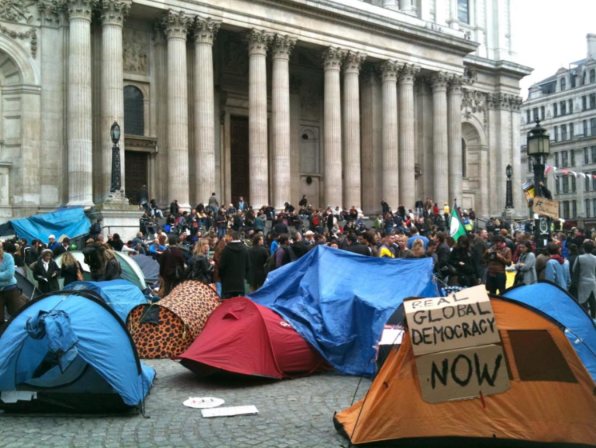
The electoral successes of Trump, Wilders and Meloni were a wake-up call. Building community from the ground up and slowly transforming policymaking still seemed worthwhile, but no longer sufficient. Democracy itself appears to be under threat. So I have turned to exploring exactly how the right captures control of the symbols and institutions we hold dear. Now I am once again focused on how influential actors can shape what is considered politically possible. But I am under no illusion that this is solely the work of philosophers sitting in dark rooms. Instead, powerful theories of change unfold when people in various walks of life think together, ideally while taking action together: academics, yes, but also artists, politicians, activists, policymakers.
Holding these disparate groups together is what a good church ought to do. Unfortunately, I don’t have one.
Tussen 2015 tot eind 2025 werd de leerstoel bekleed door Laurens ten Kate. Hier onder staat een overzicht over de invulling van de leerstoel door onze voormalig hoogleraar.
Wie is Laurens ten Kate?
Ik ben filosoof, religiewetenschapper en theoloog. Ik studeerde en werkte aan diverse universiteiten binnen en buiten Nederland, was filosofieredacteur bij Uitgeverij Boom, en kreeg in 2002 een baan als docent en onderzoeker aan de Universiteit voor Humanistiek in Utrecht (UvH).

De UvH laat zich inspireren door het vrijzinnig-humanistisch gedachtegoed en voert daarmee een kritische dialoog op wetenschappelijk en maatschappelijk niveau. Ze is een kleine zelfstandige universiteit in het oude hart van Utrecht, met rond de 650 vooral jonge, bevlogen studenten. De UvH verbindt vanuit een multidisciplinaire benadering de sociale wetenschappen (sociologie en psychologie) met de geesteswetenschappen (filosofie, geschiedenis, ethiek, religiestudies, letteren).
Ze verricht veelzijdig kritisch onderzoek naar de betekenis en de toekomst van humanisme in onze tijd, en geeft daar ook onderwijs over op het academische niveau, aan bachelor- en masterstudenten. Zelf geef ik helemaal aan het begin van de studie twee grote modules over de relatie tussen humanisme, jodendom, christendom en islam; daarnaast in de master colleges over globaliseringstheorie, en close-reading-groepen rond Charles Taylor’s boek Een seculiere tijd.
Kijk hier voor meer informatie over de UvH en over mij

Ik interesseer me vooral voor de plaats die religie inneemt in de moderne samenleving. Om die plaats beter te begrijpen, moet het moderne idee van vrijheid kritisch worden onderzocht. Dan zal het gaan over de vele manieren waarop mensen in onze tijd door verbeelding zin geven aan hun leven, of juist met de onzin ervan kunnen omgaan.
Waarover gaat de bijzondere leerstoel?
Op 11 mei 2016 hield ik mijn inaugurele rede: De vreemde vrijheid. Nieuwe betekenissen van vrijzinnigheid en humanisme in de 21ste eeuw. Daarin presenteerde ik het programma voor het werk van de leerstoel: zoeken naar nieuwe betekenissen van vrijzinnigheid en humanisme tegen de achtergrond van een globaliserende samenleving.
Die samenleving wordt steeds ingewikkelder, want het zoeken naar zin en een pluralisme van identiteiten komen steeds centraler te staan. Ik bepleit een brede visie op vrijzinnigheid, en spreek over de vrijzinnige conditie van onze cultuur. Iedereen die vrij is om zelf zin te geven aan het bestaan, telkens opnieuw, telkens anders, deelt in deze vrijzinnige conditie.


‘Voor de Internationale School voor Wijsbegeerte pitchte ik mijn boek De vreemde vrijheid, en er verscheen een web-interview met mij over het boek.’

Religie en spiritualiteit spelen hier en belangrijke rol, en veranderen mee met de samenleving. Wat te denken van de ‘erfenis’ van het christendom, en het enorme stempel dat daardoor op onze cultuur is gezet? Inspiratiebronnen voor Ten Kate zijn hier onder meer de filosofen Friedrich Nietzsche, Georges Bataille , Jean-Luc Nancy en Charles Taylor.
Zomer 2017 verscheen het glossy Mix: flexibel geloven, over een universitair onderzoek geleid door Manuela Kalsky en André van der Braak, over het mixen van elementen uit verschillende religies. Ik scheef daarin:
‘Meer dan ooit zoeken mensen in deze tijd naar de zin van hun leven en kiezen ze hun eigen levensbeschouwelijk pad. Daarmee transformeren ze bestaande religieuze en humanistische tradities én zichzelf telkens opnieuw. Dit onderzoek naar multiple religious belonging bevestigt dat fraai.
Maar hoe bouwen we een wereld waarin multiple en belonging samen kunnen gaan? De neoliberale noch de populistische leiders hebben hierop een antwoord: een samenleving waarin alles markt is of alles volk, laat zinzoekers in de steek. En loopt daarmee dus gevaarlijk achter de feiten aan die de onderzoekers scherp laten zien.’

Een speciale plaats in De vreemde vrijheid krijgt het thema verbeelding, en de spanning tussen tradities en het streven naar vrijheid. De filosoof Richard Kearney is hier een inspirator.
Een ander belangrijk thema: maatschappelijke versnelling, en de manier waarop dat doorwerkt in de levensloop van mensen, vooral van ouderen.
In De vreemde vrijheid ga ik niet alleen met wetenschappers in gesprek. De cabaretier Herman Finkers voer ik ten tonele, omdat Finkers volgens mij veel betekent voor een nieuwe, vrijzinnige omgang met religieuze beelden, woorden, verhalen en symbolen. Zoals het woord hemel: is die nu verzonnen of echt?